"Is this strategy too good to be true?"
By Dave Mabe
Here's a question from S.R. (shared with permission, edited for clarity)
S.R.
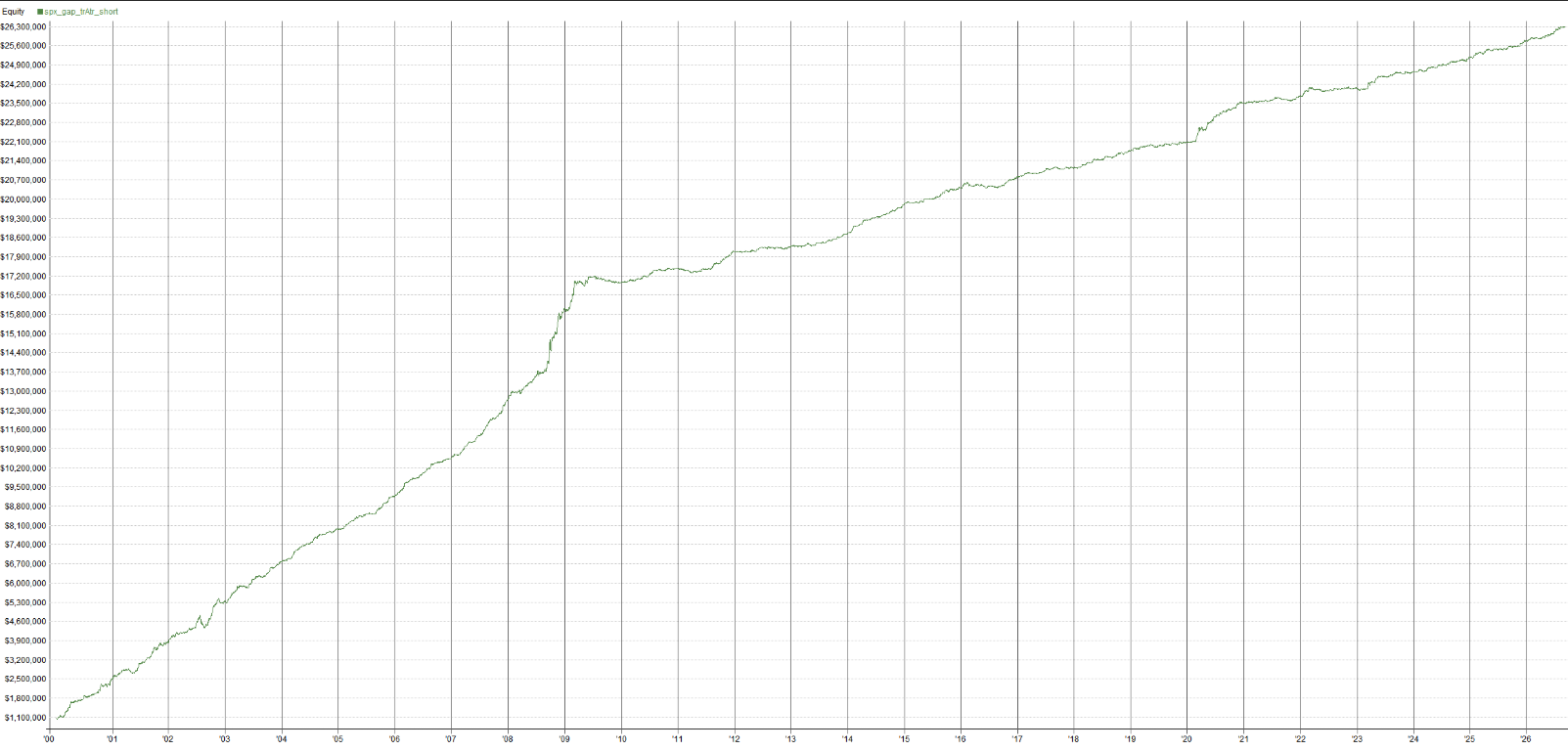
I ran a simple backtest of shorting the 3 biggest gaps in SPY stocks for the last 20 years, and the returns are… very high.
I added a simple ATR-based stop, and the results got even better.
The strategy feels so simple, yet it seems to be producing significant year-over-year returns. This feels almost impossible.
Is this too good to be true?
Dave:
Quick thoughts:
Do you have historical data for the S&P 500?
Can you generate the list fast enough to enter the trades? (chicken and egg problem on open)
Some NYSE stocks open later - do you wait for those to enter since they could be in the top 3?
Is your entry price "ideal" but in reality hard to realize?
S.R.
1. I'm using Norgate data, so the survivor bias is accounted for.
2. I'm assuming a market-on-open fill, which is definitely the 'chicken and egg' problem - but let's say we convert this to an opening range breakdown instead, where the gaps are definitively known - the edge still persists
3. I haven't accounted for the staggered NYSE open, I'm just running it as a simple 'top 3 at 9:30' filter.
4. My entry price is definitely 'ideal' in the backtest (open), but as you suspect, that is likely the biggest point of failure in real-time execution. However, let's say even if I get 2 out of the 3 right everyday it seems tradable either using LOO orders or the ORB-style entries. (The edge still seems insanely strong).
He sent this equity curve:
Anyone want to poke holes in this strategy? Hit reply and let me know.
(Thanks for sharing, S.R.)
-Dave
P.S. Have you ever made an order entry mistake that cost you money? Imagine never making a costly mistake again. Eliminate your trading mistakes with MabeKit. Get Instant Access to MabeKit