Better Strategy Starting Points
By Dave Mabe
Here's a reader question from list member Matt H. (name used with permission):
Matt H.
How do you think about universe filters? I have been struggling with this all month because each back test takes 5-7 hours and I get as many as 799,331 rows of trades when starting from 2016. Which then need to be analyzed to come up with a filter or stoploss/profit target level to test. It makes testing ideas really slow. I'm only able to run about 3 backtests per day.
Dave:
First, some background.
As you've heard me preach before, most traders who start backtesting try to create a "final version" of their strategy with their first backtest.
This is, by far, the most common mistake systematic traders make.
You'll end up wasting so much time with that approach, and if you happen to end up with a profitable strategy, it will be mostly luck.
But more importantly, you'll end up with a strategy that could be far more profitable.
Once traders begin to understand this, their workflow improves by using much better starting points.
That is, the first backtest is more about collecting data in a way that will lead to a profitable strategy.
But many traders often overcorrect here and create a starting point with far TOO many trades.
If your starting point has more than 100k trades, it's almost definitely too large.
With that many trades, your backtest is guaranteed to contain a high percentage of noise.
So when you start optimizing, you'll be fitting to that noise.
This is where universe filters come in handy.
Unlike applying filters that are predictive and directly improve the profitability of your strategy, a universe filter fences in the set of stocks your strategy is willing to consider.
So a universe filter isn't providing edge per se, but it's culling your initial set of stocks to a reasonable starting point.
If your strategy has 700k trades, it's going to contain stocks like this one:
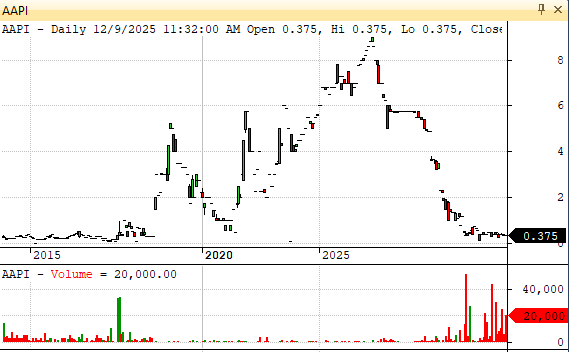 At first glance, the chart seems reasonable.
But when you look closer, you'll see that there's hardly any volume there. In fact, on most trading days, there's no volume at all!
A good universe filter eliminates this noise before it's even considered for your strategy.
That will make your entire process better:
Your backtests will be much faster
The starting points will be "cleaner" - i.e., not tainted by so much noise
Your optimization process can be solely focused on edge rather than noise removal
More signal, less noise.
Good question, Matt - thanks for sharing with the group.
-Dave
P.S. Does the market feel like it changed and left your edge behind?